
Hearing Scripture
What the first audience heard.
Every Sunday we hear words we think we understand. Fear. Helper. Lord. Blessed. They sit in familiar verses like furniture in a room we've crossed a thousand times — so familiar we stop noticing them. But the words behind them, in Hebrew and Greek, carry things the English can't quite hold. This is a reader's companion to those words — and to what the first audience heard.
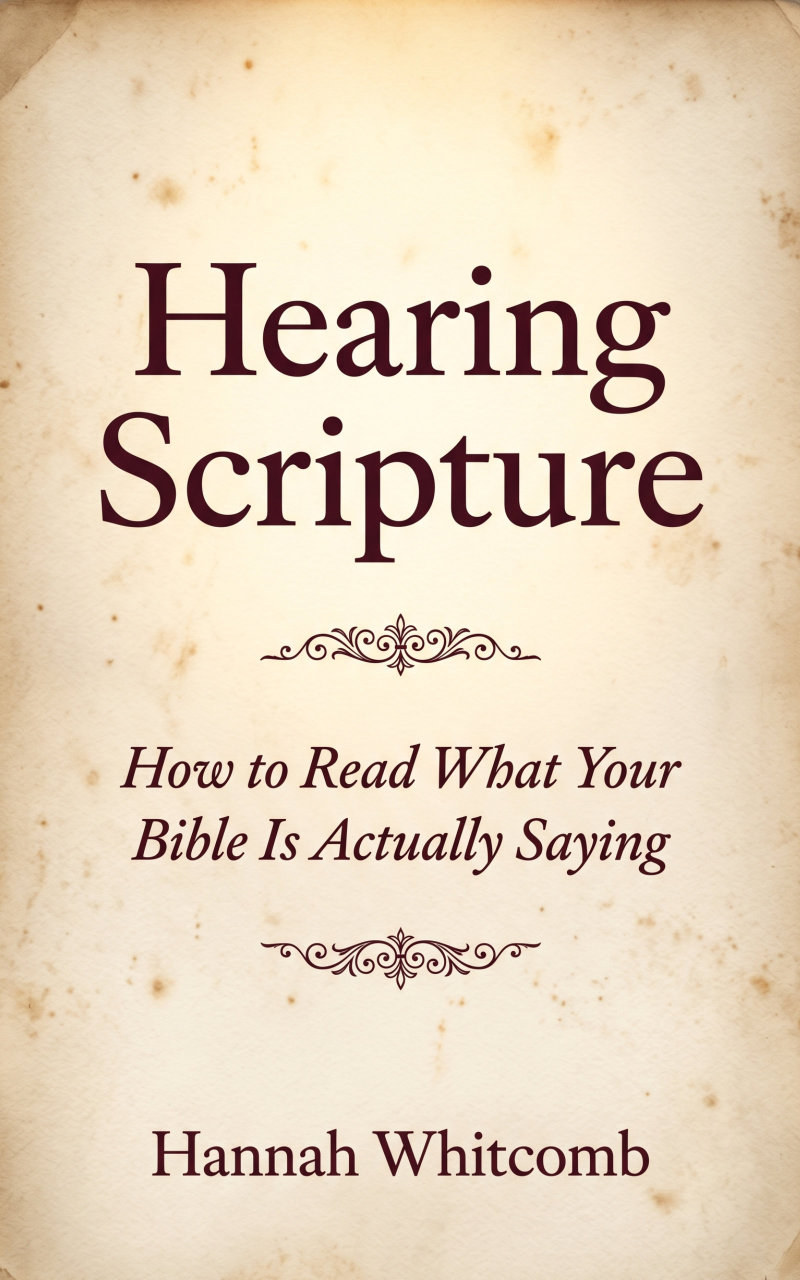
Available now on Amazon
Hearing Scripture
What the first audience heard.
The full book — every chapter, every word, in paperback or Kindle.
The chapters
- Introduction · ~10 min read Introduction the suspicion that more is going on in the original The English Bible can feel faithful but flat. This book is for the reader who suspects more is going on in the Hebrew and Greek — and wants the toolkit to hear it.
- Chapter 1 · ~9 min read The Fear That Isn't Fear yirah and the trembling kind of love The Hebrew word translated 'fear' in Proverbs 1:7 doesn't mean what English readers think it means. A look at yirah and the trembling kind of love.
- Chapter 2 · ~7 min read The Strong Help ezer and what Genesis 2 was really saying Genesis 2 calls the woman a 'helper,' but the Hebrew word ezer almost never means a junior assistant. A look at what the verse was really saying.
- Chapter 3 · ~8 min read The Word the Romans Heard kyrios and the cost of confession When the New Testament calls Jesus 'Lord,' it uses kyrios — a word that, in the first century, named Caesar. A look at the cost of confession.
- Chapter 4 · ~9 min read Blessed Is Too Quiet a Word makarios and the Beatitudes The Beatitudes' familiar opening word — 'blessed' — translates the Greek makarios. It once carried more weight than 'blessed' can hold today.
- Chapter 5 · ~10 min read The Loyalty God Keeps hesed and a word English can't quite carry The Hebrew word translated 'love' or 'mercy' is hesed — and English can't quite hold what it carries. A look at the loyalty that doesn't leave.
- Chapter 6 · ~10 min read The Word That Was logos and the John you've been mishearing John opens his gospel with 'In the beginning was the Word.' The Greek logos carries two enormous histories at once — and English keeps only one.
- Chapter 7 · ~9 min read The Coming That Wasn't What We Thought parousia and the word the church has been mishearing The Greek word for the 'second coming' isn't really about an arrival. Parousia means presence — and the difference changes what we're waiting for.
- Chapter 8 · ~12 min read The Bread of Life what Jesus's audience heard when he said 'I am the bread of life' When Jesus said 'I am the bread of life,' the Greek artos carried daily survival, the manna, the temple bread of the Presence, and the coming Passover — all at once.
- Chapter 9 · ~10 min read The Kingdom at Hand malkuth and what Jesus was really announcing The Hebrew malkuth means a reign, not a place. When Jesus said 'the kingdom of God has come near,' his first audience heard something more dynamic than the English suggests.
- Chapter 10 · ~10 min read Born of Water and Spirit what Nicodemus actually heard in John 3 Jesus's 'born of water and Spirit' in John 3 is one prophetic picture, not two separate births — and Nicodemus, the senior teacher, should have recognized it instantly.
- Chapter 11 · ~11 min read Son of Man bar enasha and the title that meant more than humility Jesus's most-used self-title sounds humble in English. In Aramaic, bar enasha points to Daniel 7 — and what his audience would have heard was anything but modest.
- Chapter 12 · ~10 min read I Am egō eimi and the name behind the words Jesus's 'I am' statements use the same two Greek words the Septuagint used for God's self-naming in Isaiah. The English flattens what his first audience caught immediately.
- Chapter 13 · ~13 min read The Eye of the Needle what Jesus's saying about the camel actually meant — and the legend that has softened it Jesus's 'easier for a camel to go through the eye of a needle' was meant as an impossibility. The familiar pulpit story that softens it didn't exist until centuries later.
- Chapter 14 · ~13 min read In the Name of epikaleō and what calling on his name meant Praying 'in Jesus's name' is more than a polite closing. The Greek epikaleō reaches back to Genesis 4 and the first organized act of worship.
- Chapter 15 · ~13 min read Lead Us Not Into Temptation peirasmos and what Jesus actually taught us to pray The line many Christians have stumbled over — 'lead us not into temptation' — isn't quite what Jesus prayed. A look at peirasmos and the testing it actually names.
- Chapter 16 · ~18 min read The Lord's Prayer in Full what we are actually saying when we say the prayer Jesus taught us A line-by-line walk through the Lord's Prayer in its original Aramaic and Greek — what every phrase carried that English doesn't quite hold.
- Chapter 17 · ~16 min read The Beatitudes as a Passage what eight blessings, read together, are doing The Beatitudes aren't a random catalog of pious sentiments. They're a composed passage — framed, structured, and laying out the constitution of the kingdom Jesus had just announced.
- Chapter 18 · ~16 min read The Good Samaritan what one of Jesus's most famous parables originally meant to say The Good Samaritan has been domesticated. The parable that scandalized its first audience — and the hero no one in the lawyer's world would have chosen — looks very different put back in context.
- Chapter 19 · ~21 min read The Letter to Philemon what one of the shortest books in the Bible was actually doing Paul's shortest letter is also one of his most carefully constructed pieces of moral persuasion — and the New Testament's most concentrated engagement with slavery.
- Chapter 20 · ~16 min read The Magnificat what Mary actually sang in Elizabeth's doorway Mary's song in Luke 1 is half tender meditation, half political upheaval — and the church has spent two thousand years trying to quiet down the second half.
- Chapter 21 · ~17 min read The Nazareth Sermon what Jesus said in his hometown synagogue, and why his neighbors tried to throw him off a cliff Jesus's inaugural sermon. He read from Isaiah, sat down, and announced the passage had been fulfilled. Ten minutes later his neighbors were trying to kill him.
- Chapter 22 · ~20 min read The Olivet Discourse what Jesus said about the future, and the long argument Christians have had about what it means Jesus's longest single block of teaching about the future — the most contested passage in the New Testament. What the Greek and the history can clarify, and what they can't.
- Chapter 23 · ~19 min read The Foot Washing what Jesus did the night before he died, and why the disciples could not bear to watch him do it Foot washing in the first century was reserved for the lowest household slave. The night before he died, Jesus took the towel. The scene was a category violation.
- Chapter 24 · ~10 min read The Road to Emmaus the conversation we wish we had a transcript of The Road to Emmaus is usually preached as a recognition story. The seven miles before that moment are something else — Christian hermeneutics being invented.
- Chapter 25 · ~11 min read The Last Supper heard at a Passover meal in Jerusalem The night Jesus took bread and cup was not an ordinary night. It was Passover — and the room and the ritual were doing more than the modern Christian usually hears.
- Chapter 26 · ~12 min read The Second Temple Imagination the four hundred years no one taught you about Between Malachi and Matthew, four hundred years pass. The familiar reading imagines those years as empty. The world the New Testament steps into could not be more different.
- Chapter 27 · ~13 min read Honor and Shame the social currency of Jesus's world The Gospels feel like intimate spiritual conversations to modern readers. The first audience heard them inside an honor-and-shame system the modern Western world has largely forgotten.
- Chapter 28 · ~12 min read Patrons and Clients the relational world Paul kept stepping into Modern English makes grace feel warm and fuzzy. The Greek charis was a technical term in a patronage system Paul's audience knew intimately — and used differently than we do.
- Chapter 29 · ~12 min read The Supernatural World They Took for Granted angels, principalities, and the unseen realm the New Testament keeps assuming The New Testament assumes a supernatural worldview modern readers have been trained to dismiss as metaphor — or to over-literalize. Neither matches what the first audience heard.
- Chapter 30 · ~12 min read The Apocalyptic Mood what Jesus's vocabulary was made of Jesus's harder sayings — furnace, gnashing of teeth, harvest — aren't literal predictions or arbitrary metaphors. They come from a genre with rules the first audience knew.
- Chapter 31 · ~13 min read The Maccabean Memory why martyrdom was already a category When Stephen looked up into heaven, a Jewish vocabulary of faithful death had already been forming for two hundred years. The hope had been rehearsed.
- Chapter 32 · ~13 min read What a Synagogue Sounded Like the building Jesus grew up in When the New Testament says Jesus went into the synagogue, the modern reader pictures a church. The first-century synagogue was something stranger, more multipurpose, more embedded in town life.
- Chapter 33 · ~15 min read What a Household Was the social unit the New Testament keeps assuming The household codes assume the modern nuclear family. The Greek oikos was something else entirely — multi-generational, economic, religious, with a single legal head over a sprawling unit.
- Chapter 34 · ~15 min read The Septuagint in the Air the Bible the New Testament was actually reading The Bible most New Testament writers were actually reading wasn't the Hebrew Bible — it was a Greek translation. The wording sometimes diverges, and the theology rides on those differences.
- Chapter 35 · ~15 min read The Memory of Exile a wait the modern reader does not feel When Jesus began preaching, the room had been waiting six hundred years. The exile, in the senses that mattered most, was still going on — and the Gospels assume that mood.
- Chapter 36 · ~15 min read Why English Carries What It Carries the Bible came through hands The English Bible is the product of two thousand years of translation done by hands — paid for, sometimes, in lives. Knowing that history changes what reading it means.
- Chapter 37 · ~15 min read Reading With the Early Church a different kind of reader The early church read scripture in a way richer and more layered than the historical-critical method modern Christians have been trained in. Some of those moves are still alive.
- Chapter 38 · ~15 min read The Books in the Room what else they were reading First-century Judaism read more than the Hebrew Bible — apocalyptic visions, wisdom collections, rewritten narratives. The New Testament writers echoed all of it.
- Chapter 39 · ~14 min read The Long Memory of the Church what the calendar remembers For most of Christian history, the deepest reading of scripture has happened together — in the lectionary, the church year, the liturgical calendar. The patterns encode careful readings.
- Chapter 40 · ~12 min read A Small Toolkit what you have been doing Five practices, drawn from what the book has been doing for forty chapters. A small set of tools that fit in a pocket, for reading scripture the way it asks to be read.
- Chapter 41 · ~8 min read Older, Richer, Closer the three words on the cover The three words on the book's cover named what every chapter was doing. The conclusion names them: older, richer, closer reading of scripture's original sense.
- Epilogue · ~4 min read Epilogue the reader, years later, with her Bible open A closing image: a reader, years after she's finished the book, with her Bible open on her lap. The book has done what it can. The toolkit is in her hands.
About this project
Hearing Scripture is a reader's companion to the Hebrew and Greek words behind familiar verses — written for Christians who love the Bible and want to hear, as nearly as possible, what its first audience heard. Read more about the project →